

One of my favorite art styles to teach is surrealism because it pushes a lot of students out of their comfort zones. Surrealism, an art period in the early 20th century, focuses on combining art literature, dreams, and the unconscious in interesting ways. One of the most familiar surrealist artists and artwork is Salvador Dali and his painting The Persistence of Memory, is a good artwork to show to your students/children to discuss the movement. When I begin my lesson, I will show this painting and ask students to try to identify things they see.
Some of the answers will be
Melting clocks
Mountains and the ocean
A weird face
Ants
Flat, mirror like platform
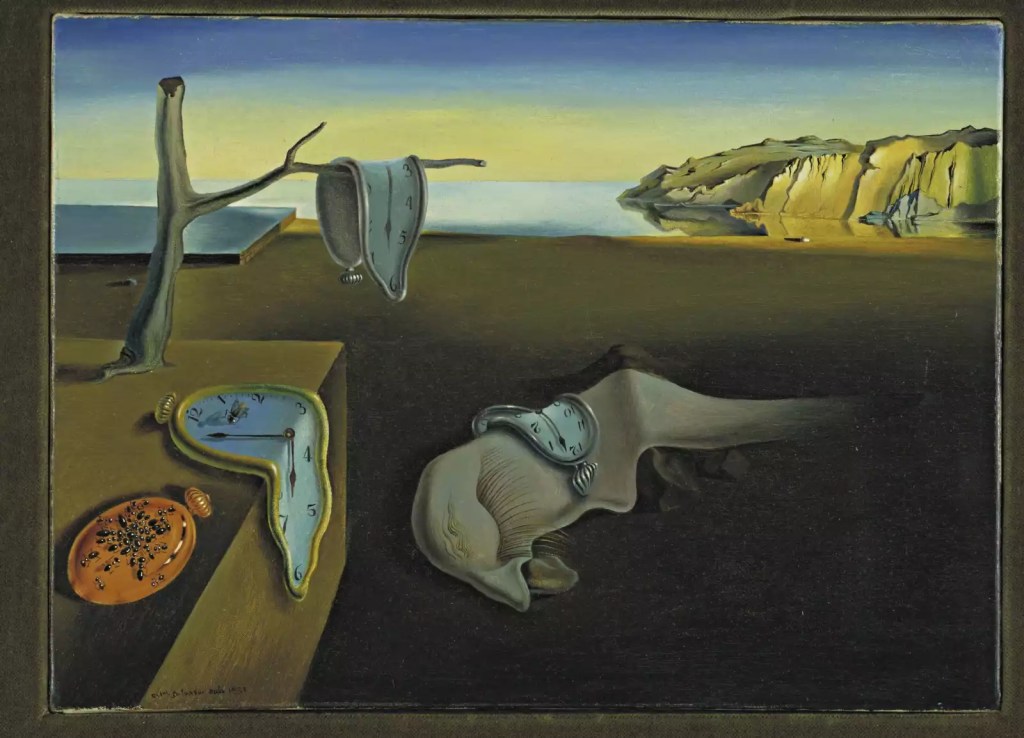
Then I will ask them what they think the artist is saying with these images. I usually get some interesting answers, some closer to the actual answer than not, but the point is to start thinking about art and not to be right. When their comments are finished, I then describe what symbolism the objects and images mean
Melting clocks: represents time but are melting to symbolize time moving differently in dream states. How time might seem longer in a dream than it is in reality.
Mountains and the ocean: Dali’s childhood home
A weird face: a self portrait of the artist
Ants: decomposition and death (stemming from a childhood memory of seeing ants swarming a dead animal)
Flat, mirror like Platform: difference between reality and imaginary
Another online tool that you can utilize for this unit is Khan Academy. This website has numerous articles and videos on Surrealism as well as other art movements and art history topics. Items can be assigned prior to the start of the discussion to give students a good background on the topic prior to the start of the lesson.
Once the background information is presented, I weave in a technical element into our surrealist drawings. For this project, I decided to teach my students how to draw a proportionally, realistic eye. They would then practice drawing eyes and incorporate it into a surrealist drawing. Below is a video I created for my students that was the same as the live presentation I taught on the first day of the lesson. I created a video because, for me, I a, a kinesthetic learner and have to be doing the skill as it is being taught. I did the demonstration live, but then offered the video for anyone who wanted to watch it at their own pace. It turned out to be very successful for it was watched over 100 times and I only had 40 some students in my two classes. Here is the video
Steps
- Introduce lesson through discussion on Surrealism using Persistence of Memory image and or through Khan Academy
- Demonstrate how to draw a realistic eye and give requirements of the drawing
- In the surrealist style
- At least one eye must be included and emphasize realistic proportions
- Finish in colored pencils
- Students practice drawing realistic eyes (at least three looking in different directions) Video provided for students to view at their own pace
- Create a rough draft of their surrealist eye drawing idea
- Redraw final image and finish with color pencils with shading and value


Student examples of completed images

 In the Art Room with Mrs. D